
Traders searching for using GEX to predict market maker hedging are usually trying to understand whether gamma exposure can anticipate dealer hedging behavior as price moves through key levels. GEX cannot predict those actions with certainty, but it can help traders estimate how hedging flows may respond under different positioning conditions.
This matters because dealer hedging activity can influence short-term market behavior. Depending on positioning and other market conditions, hedging flows may work against price movement or reinforce it.
Understanding these mechanics can provide context for why the market sometimes behaves differently around certain price levels – especially during high-volume options expirations or volatile sessions.
What Traders Mean by Market Maker Hedging
Market makers frequently take the opposite side of options trades in order to provide liquidity. As a result, they may carry directional exposure that can be dynamically hedged as price and other market inputs change.
Dealers can manage some of this exposure by buying or selling shares of the underlying asset.
The amount and direction of this hedging activity can change rapidly depending on:
Gamma exposure can help traders estimate how these hedging flows may interact with price movement.
Positive Gamma: Why Markets May Be More Stable
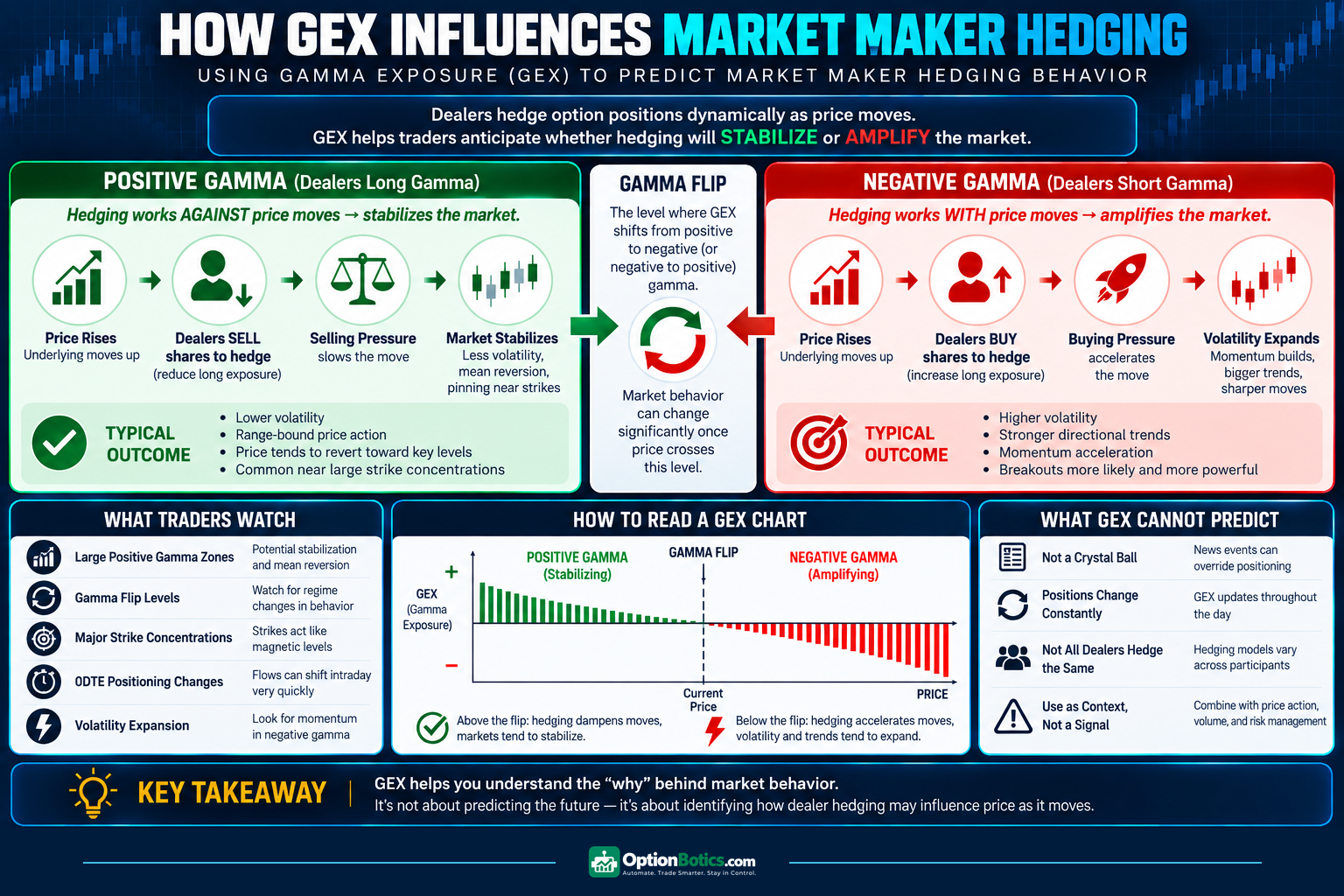
In a positive gamma environment (often called long gamma), modeled dealer hedging flows may work against price movement, which can have a stabilizing effect.
In this environment:
These potential hedging flows work against the direction of the price move and may contribute to:
This framework can help explain why price sometimes appears relatively stable around strikes with substantial options positioning.
Negative Gamma: Why Volatility Can Expand
In a negative gamma environment (often called short gamma), modeled dealer hedging flows may reinforce price movement instead of working against it.
In this environment:
These potential hedging flows move with the direction of price and may contribute to:
Traders may pay close attention to these environments because reinforcing hedging flows can become one factor contributing to faster price movement.
For a practical breakdown of how traders apply these concepts, see how traders actually use GEX in options trading.
Why Gamma Flip Levels Matter
One of the important concepts in GEX analysis is the gamma flip.
This is a modeled level where estimated dealer positioning may shift from positive gamma to negative gamma (or vice versa).
Traders monitor these levels because the hedging environment may change as price moves from one gamma regime to another.
For example:
These relationships are not guaranteed, but they can help traders frame expectations for how hedging flows may interact with price around a modeled transition level.
What Traders Actually Watch
Traders using GEX are generally not trying to “predict the future.” Instead, they are estimating how dealer hedging flows may react if price moves into key areas.
Common things traders monitor include:
Some traders combine this with breakout systems and momentum strategies to identify areas where volatility may accelerate.
See also opening range breakout strategies.
What GEX Cannot Predict
Gamma exposure is a useful framework, but it is not a crystal ball.
Important limitations include:
Because of this, GEX should be used as contextual information rather than a standalone trading signal.
Using GEX with Automated Trading Systems
GEX data can also be incorporated into rule-based trading systems as one source of market context.
For example, a system could be designed to:
This can make GEX one input within a broader rule-based process rather than treating it as a standalone trading signal.
For more on this, see using automation in options trading.
Final Thoughts
Using GEX to estimate market maker hedging behavior is less about predicting exact price movement and more about understanding how positioning may influence market structure.
Positive gamma environments may be associated with more stabilizing hedging flows, while negative gamma environments may be associated with flows that reinforce volatility and momentum.
Understanding these dynamics can give traders additional context for interpreting price behavior around key levels – especially during high-volume expiration periods and volatile trading sessions.
If you want to explore how traders use GEX and automation together inside structured systems, review the tools and workflows featured on OptionBotics.com.