
One of the biggest frustrations in trading is the feeling that you constantly need to watch the market. Charts move, positions change, alerts fire, and every open trade can create another decision that demands attention.
Automation changes that workflow by turning strategy execution into a structured process. Instead of manually handling every repeatable decision, traders can define rules for entries, exits, risk controls, and monitoring – and let those rules handle much of the routine execution during market hours.
Why Constant Manual Oversight Becomes a Problem
Manual trading often creates inconsistent execution because decisions are being made in real time, frequently while money is already at risk.
A trader may begin with a clear plan but behave differently once the market starts moving. Constant monitoring can encourage unnecessary decisions that were never part of the strategy.
Common problems include:
- Watching charts for hours waiting for setups
- Entering trades too late after hesitating
- Changing exit plans once a trade is under pressure
- Managing similar positions differently
- Missing valid opportunities while away from the screen
Over time, constant monitoring can create fatigue and make it harder – not easier – to follow a repeatable process.
What Strategy Execution Actually Includes
Strategy execution is much more than clicking a button to open a position. A complete workflow can involve multiple decisions before, during, and after a trade.
When those decisions can be expressed as objective rules, many of them can be handled systematically instead of requiring continuous manual attention.
What Can Realistically Be Automated?
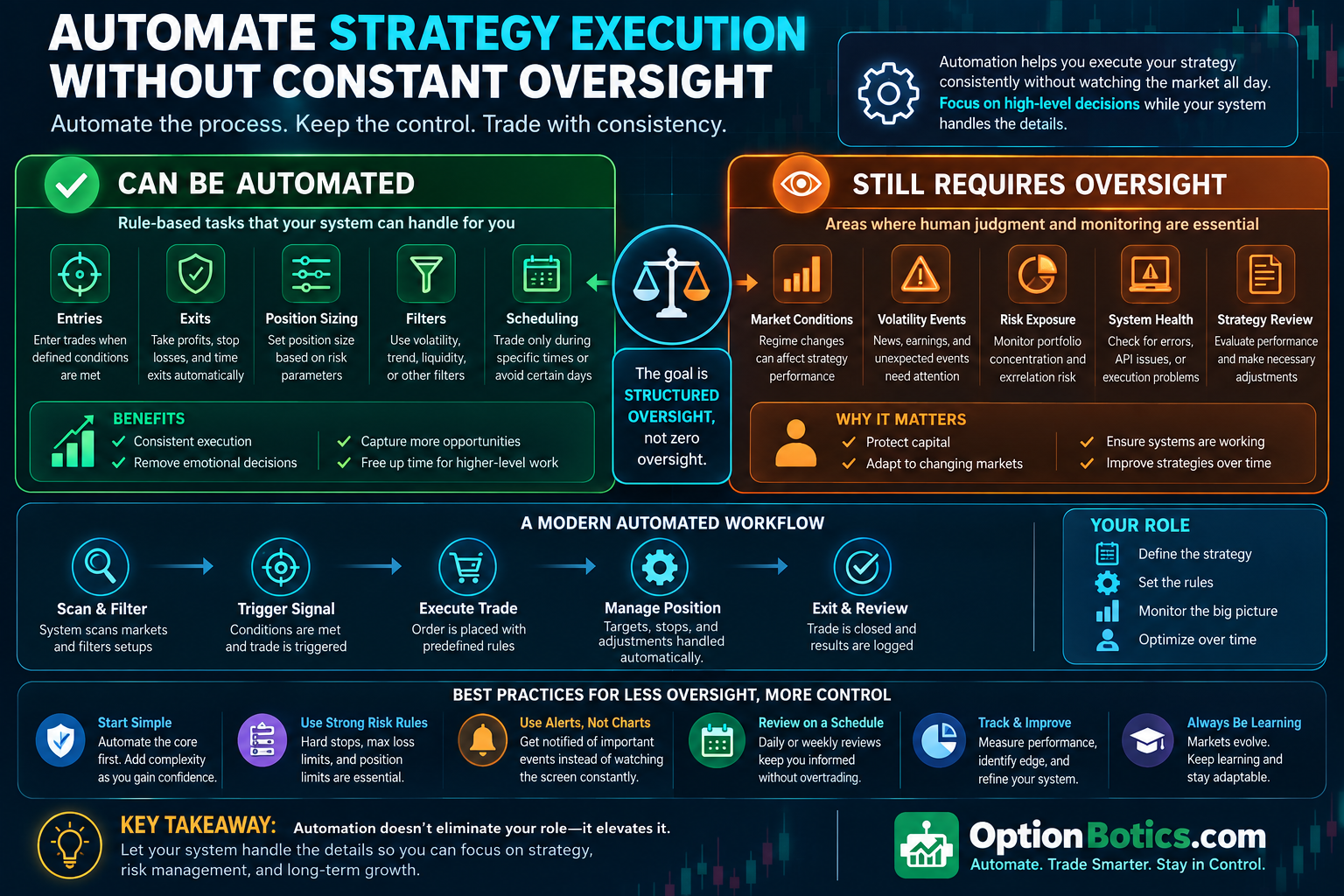
Modern rule-based systems can automate a significant portion of strategy execution. The key is that the decision must be definable in advance.
For a broader look at turning strategy logic into automated rules, see how to automate options trading without coding.
What Should Still Require Trader Oversight?
Reducing screen time does not mean surrendering control. Some decisions depend on context that may fall outside the strategy’s normal operating assumptions.
Traders should still pay attention to areas such as:
- Major market regime changes that alter the environment in which the strategy was designed to operate
- Unexpected volatility events that fall outside normal assumptions
- Portfolio concentration across positions or strategies
- Broker, connectivity, or execution failures that prevent rules from operating correctly
- Performance degradation that suggests a strategy may no longer be behaving as expected
How Traders Reduce Constant Monitoring
A well-designed automated workflow changes how you monitor trading activity. Instead of continuously watching every tick, you define which events actually deserve attention.
The result is not zero oversight. It’s a shift from constant observation to intentional monitoring.
The automation platform we use and recommend lets options traders build bots that monitor predefined conditions, execute rule-based strategies, manage positions, and apply exit logic during market hours – while keeping the trader in control of the rules.
Why Risk Management Matters Even More with Automation
Automation can improve consistency, but consistency works in both directions. A well-designed rule can be followed reliably – and so can a poorly designed one.
Because automated systems can continue executing without hesitation, risk controls should be built into the strategy rather than treated as an afterthought.
For a deeper look at these safeguards, see trading bot risk management and how to prevent automated strategy blowups.
Common Mistakes When Automating Strategy Execution
Treating Automation Like “Set and Forget”Markets and strategies change. Automation still needs review and oversight.
Overcomplicating the StrategyToo many conditions can make a system fragile, difficult to understand, and harder to maintain.
Ignoring Risk ControlsAutomation can scale poorly controlled exposure just as efficiently as it executes good rules.
Skipping Proper TestingStrategy logic should be tested and validated before meaningful live capital is placed at risk.
Using Automation with Options Strategies
Options strategies can be particularly well suited to rule-based execution because many of their decisions can be expressed objectively in advance.
- Credit spreads with defined entry filters, profit targets, and loss rules
- Iron condors with standardized strike selection and trade management
- Momentum systems triggered by objective directional conditions
- Breakout strategies based on predefined price or technical thresholds
The advantage is not that automation makes these strategies profitable. It is that the same strategy rules can be evaluated and executed consistently each time the qualifying conditions occur.
For more examples, see automated options trading strategies that translate well into rule-based systems.
What a Sustainable Automated Workflow Looks Like
This creates a fundamentally different relationship with the market. Instead of being responsible for every repetitive action, the trader becomes responsible for the system that governs those actions.
Final Thoughts
Automation can reduce the need to constantly watch charts and manually manage every stage of a strategy, but that doesn’t mean removing yourself from the process entirely.
The stronger approach is to automate decisions that can be defined objectively, establish safeguards around risk, and reserve human attention for exceptions, changing conditions, and periodic strategy review.
The goal isn’t to stop paying attention. It’s to stop spending attention on decisions your rules can handle consistently for you.