
Gamma exposure (GEX) is often discussed as a way to understand market behavior – but many traders struggle to turn that understanding into actual trades.
This guide focuses on how traders practically use GEX in options trading, including how it can be applied within structured, rule-based strategies.
If you’re new to gamma exposure, you may want to start with a basic explanation first.
What GEX Actually Tells You
Gamma exposure provides insight into how options positioning may influence price movement through hedging activity.
In practice, traders use GEX to understand:
Instead of predicting direction, GEX helps define how price is likely to react around key levels.
Those reactions are often connected to market maker hedging flows, especially around major strike concentrations.
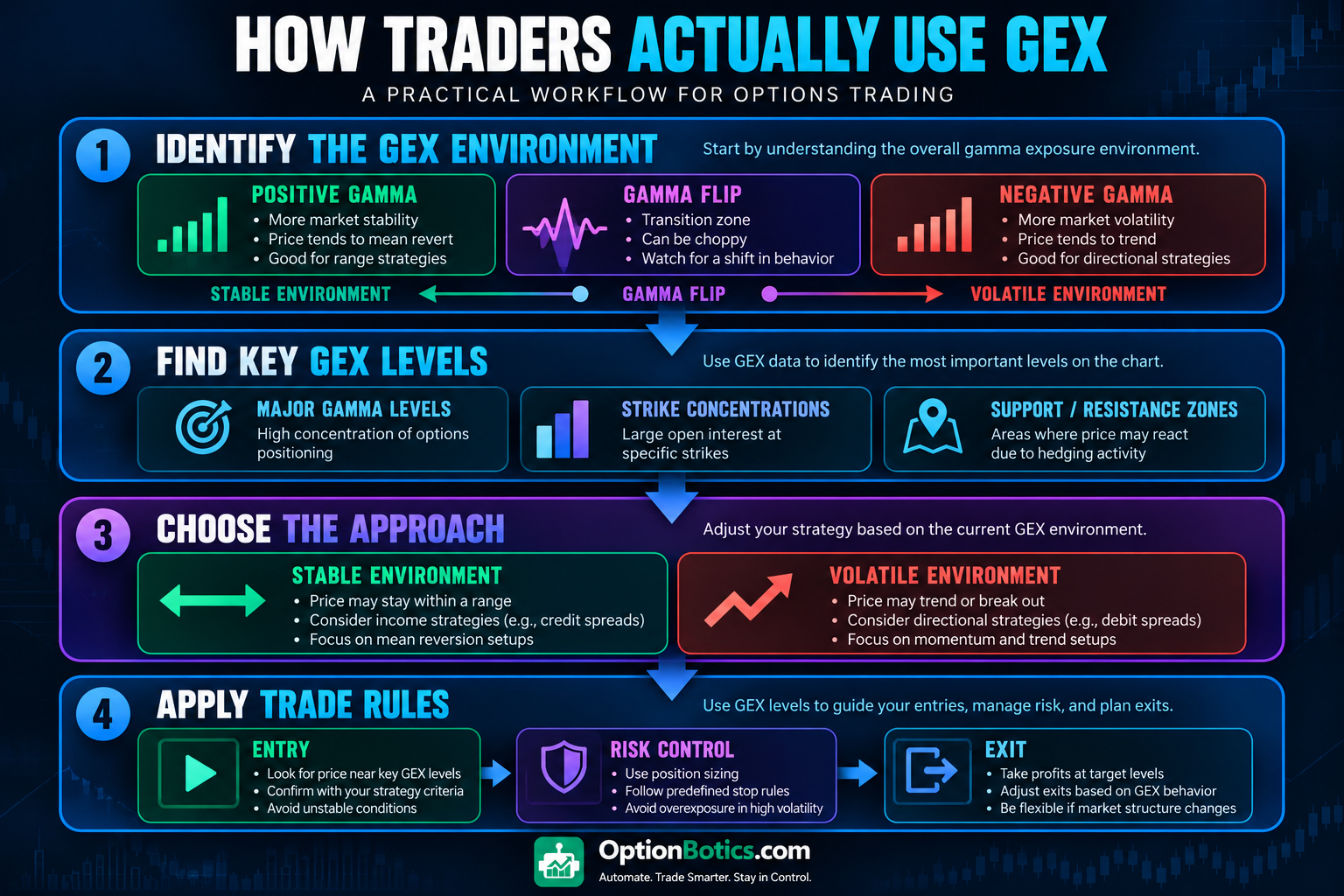
How Traders Use GEX Levels in Real Setups
Most traders use gamma exposure as a structural tool rather than a standalone signal.
Common approaches include:
For example, in a more stable environment, traders may expect price to stay within a range. In a more volatile environment, they may expect stronger directional moves.
Using GEX for Entry and Exit Decisions
GEX is often used to improve timing rather than generate signals on its own.
Traders may use it to:
This makes it especially useful when combined with structured strategies rather than discretionary trading.
→ See: How to Set Up Automated Exit Strategies in Options Trading (Without Losing Control)
How GEX Fits into Automated Trading Systems
One of the most practical uses of gamma exposure is within rule-based automation.
Instead of manually interpreting charts, traders can define specific conditions based on GEX data.
For example, a system might:
This removes subjectivity and ensures that decisions are consistent across all trades.
→ See: How to Automate Options Trading Without Coding (Beginner-Friendly Guide)
Combining GEX with Strategy Selection
GEX is often used alongside specific options strategies rather than in isolation.
For example:
This allows traders to align their strategy with current market conditions.
Common Mistakes When Using GEX
1. Treating It as a Prediction Tool
GEX provides context – not certainty. It should guide decisions, not replace them.
2. Overcomplicating the Data
Many traders focus too much on calculations instead of understanding behavior.
3. Ignoring Risk Management
Even strong setups can fail without proper risk controls.
→ See: trading bot risk management
Common Questions About Using GEX
Can you trade using GEX alone?
No. GEX is best used as a supporting tool within a structured strategy.
Is GEX useful for intraday trading?
Yes. It is commonly used to understand intraday price behavior and key levels.
Does GEX work in all market conditions?
No. Its effectiveness depends on volatility and overall market structure.
Can GEX be automated?
Yes. GEX can be incorporated into rule-based systems to guide entries, exits, and strategy selection.
Final Thoughts
Gamma exposure is most powerful when used as part of a structured system rather than a standalone signal.
By combining GEX with clearly defined strategies and consistent execution, traders can better align their decisions with actual market behavior.
If you want to explore how traders are applying GEX within structured, rule-based systems, review the tools and workflows featured on OptionBotics.com.