
A sudden surge in options activity can be worth investigating. It can show that a particular stock, strike, or expiration is attracting unusual attention.
What it usually cannot do by itself is explain why the trades occurred, what position the traders already held, or what happens next. That distinction is what separates useful options-flow research from simply chasing large trades.
What Is Unusual Options Activity?
Options markets generate trading activity across many strikes and expirations every day. Some contracts trade heavily on a routine basis. Others normally see relatively little activity.
Unusual options activity generally refers to options trading that stands out relative to an expected or historical baseline. Depending on the research method or tool, that could involve unusually high contract volume, volume relative to open interest, large individual trades, concentrated activity at particular strikes, or other deviations from typical behavior.
What Unusual Activity Can Tell You
Used carefully, unusual options data can help narrow a large market into a smaller group of contracts or underlyings that deserve additional research.
That last use is especially important. Unusual activity can function as a discovery mechanism without being treated as a recommendation to copy the trade.
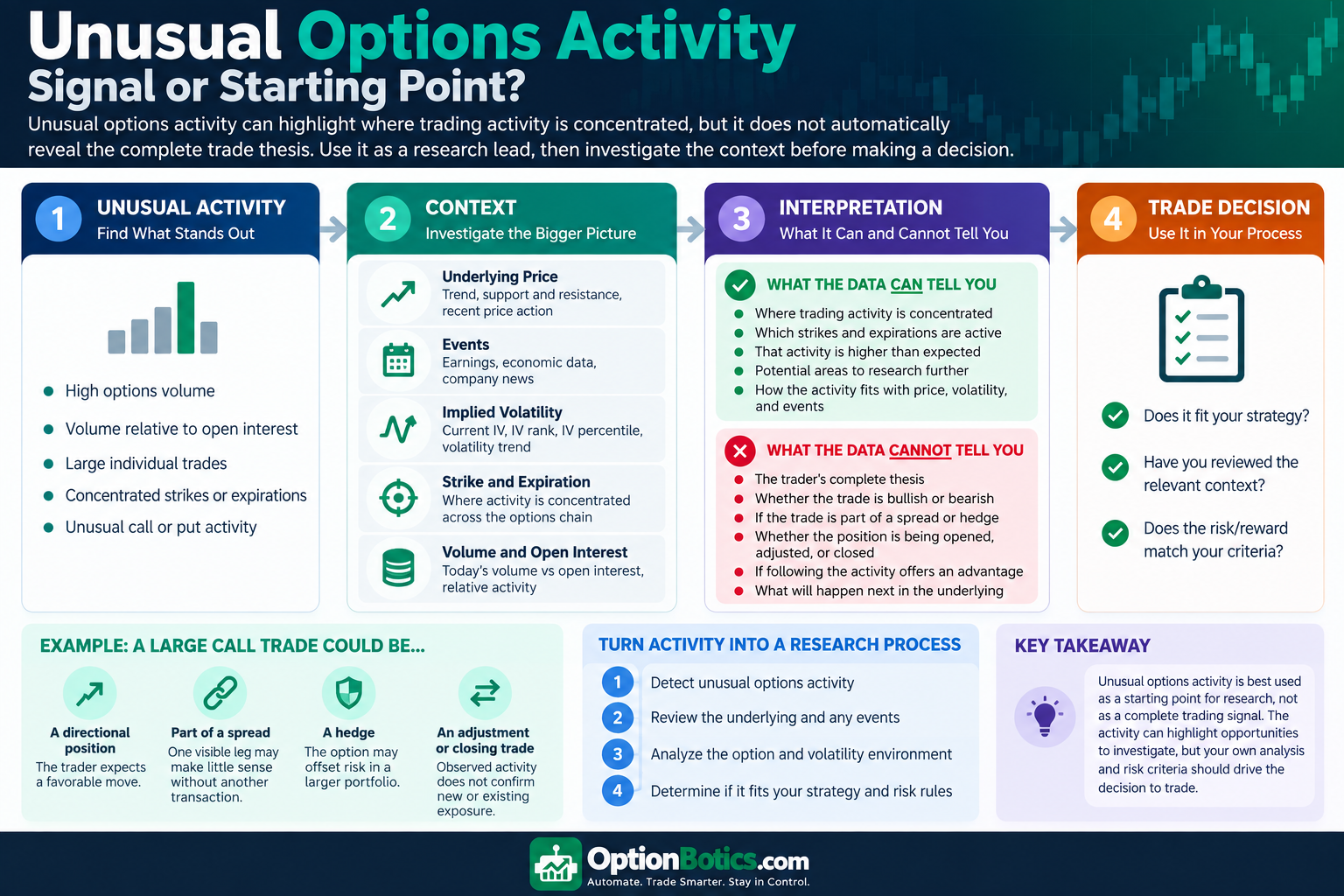
A Large Call Trade Is Not Automatically Bullish
This is one of the most important limitations of options-flow analysis.
Suppose you notice unusually large call activity. It may look bullish at first glance, but the transaction visible in the options market does not necessarily reveal the trader’s complete position.
The same caution applies to put activity. A large put transaction is not automatically evidence that someone expects the stock to decline.
Volume Relative to Open Interest Can Be Useful, but It Needs Context
One common way traders notice unusual options activity is by comparing current volume with existing open interest.
If a contract has traded far more contracts today than its reported open interest, that can indicate substantial new activity is occurring relative to the number of positions that were open when the latest open-interest figure was established.
But even that does not answer every question.
Because these metrics are frequently misunderstood, the next article in this series will look specifically at options volume vs open interest and what each can contribute to trade research.
What to Investigate After You Find Unusual Activity
Finding the activity should start a sequence of questions rather than end one.
Do Not Confuse Activity With an Edge
A scanner can identify something unusual with considerable precision while still knowing nothing about whether following that activity has a favorable expected outcome.
This distinction matters because unusual activity naturally attracts attention. Large numbers and concentrated trades can create the impression that another market participant knows something important.
The more useful approach is to treat unusual activity as one input in a broader research process.
That process can include the same factors discussed in our guide to researching an options trade before entry: liquidity, volatility, events, expiration, strike selection, strategy structure, and risk.
From Unusual Activity to a Research Candidate
This framing changes the role of an unusual options activity scanner. Instead of asking it to tell you what to trade, you are asking it to identify where something unusual is happening so you can decide whether it matters.
Find the Activity, Then Investigate the Story
Unusual options activity can identify contracts, strikes, expirations, and underlyings attracting exceptional trading interest. That makes it useful for discovery and research.
It does not automatically reveal whether the observed trader is bullish or bearish, whether a transaction is part of a larger position, or whether following the activity offers an attractive trade.
The stronger workflow is to detect the activity, examine its context, research the option, and then decide whether the opportunity fits your own strategy and risk rules.