
The Opening Range Breakout (ORB) is one of the most widely used intraday trading strategies. It is simple in concept, rule-based by design, and adaptable across multiple markets.
For options traders, ORB offers a structured way to trade intraday momentum – but execution consistency is where most traders struggle.
This is where backtesting and automation can make a meaningful difference. When applied correctly, they allow traders to follow the same rules every time without hesitation or inconsistency.
What Is an Opening Range Breakout?
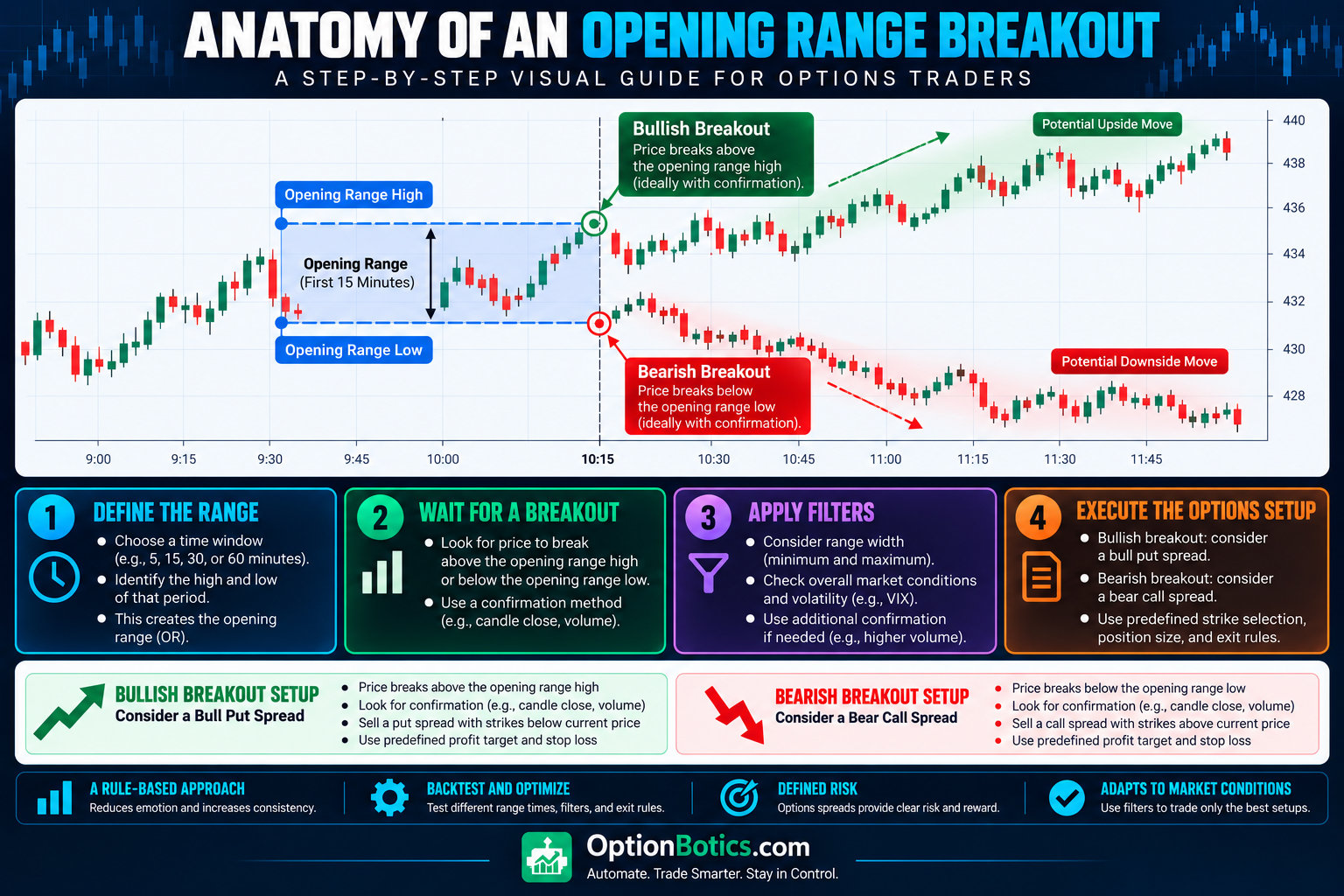
The opening range refers to the high and low of a defined time window after the market opens. Common timeframes include the first 5, 15, 30, or 60 minutes of the trading session.
Once that range is established, traders look for price to break above the high or below the low. That breakout becomes the signal for a potential trade.
The idea is simple: early market activity defines a range, and a break from that range signals directional momentum.
Why ORB Works in Intraday Markets
The first portion of the trading day often contains the highest volume and volatility. Institutional positioning, overnight news, and market sentiment all contribute to early price movement.
When price breaks out of the opening range, it can indicate:
- Continuation of strong directional momentum
- Imbalance between buyers and sellers
- Increased participation from larger market players
How to Trade ORB with Options
Using Credit Spreads
One of the most common ways to trade ORB with options is through credit spreads. These provide defined risk and can benefit from directional movement without requiring perfect timing.
Consider a bull put spread
Consider a bear call spread
Traders often place the short strike near the opposite side of the opening range or at a level that aligns with expected support or resistance.
Using Defined Entry Rules
Instead of reacting emotionally, ORB trades should follow a predefined structure:
Choose the opening range duration, such as 15 or 30 minutes.
Specify the condition, such as a close above or below the range.
Set a latest entry time to avoid late trades.
Filter trades using range width or volatility.
Why Backtesting ORB Strategies Is Critical
ORB strategies can look simple, but small rule changes can significantly impact results. Without testing, it is difficult to know whether a setup has a real edge.
- Evaluate performance across different market conditions
- Test multiple opening range durations
- Measure win rate, drawdown, and consistency
- Compare variations of the same strategy
For example, changing the range from 15 minutes to 30 minutes – or adjusting entry timing – can produce very different outcomes.
Backtesting removes guesswork and replaces it with data-driven decisions.
How Automation Improves ORB Execution
Even with a well-defined ORB strategy, manual execution introduces challenges:
Automation solves these issues by enforcing rules exactly as defined.
With a rule-based system, you can:
- Trigger trades immediately when breakout conditions are met
- Apply consistent position sizing across trades
- Follow entry and exit rules without deviation
- Manage multiple opportunities simultaneously
This consistency is especially important for intraday strategies like ORB, where timing plays a critical role.
Common Mistakes Traders Make with ORB
Entering Late
Chasing a breakout after it has already moved reduces the probability of success and alters the risk/reward profile.
Ignoring Range Quality
Not all opening ranges are equal. Extremely narrow or overly wide ranges can produce unreliable signals.
Overriding Rules
Second-guessing entries or exits leads to inconsistent results and makes it difficult to evaluate performance.
Skipping Backtesting
Without historical testing, traders rely on assumptions rather than data.
Building a Simple ORB Framework
A basic ORB options strategy might include:
This structure can then be refined using backtesting and adjusted based on performance metrics.
Final Thoughts
The Opening Range Breakout is a naturally rule-based strategy, which makes it a strong candidate for automation.
By combining clearly defined entry conditions, structured risk management, and consistent execution, traders can reduce variability and better evaluate their results over time.
If you want to see how traders are building, testing, and automating ORB strategies in a structured way, explore the tools and workflows highlighted on OptionBotics.com.