
Many automated options strategies are designed around premium collection or range-bound markets. An automated momentum strategy takes a different approach: it looks for evidence that price is beginning – or continuing – to move decisively in one direction, then uses predefined rules to participate in that move.
Momentum trading is particularly well suited to systematic execution because timing matters. Automation can help traders monitor conditions consistently, respond when predefined criteria are met, and manage the resulting position according to rules rather than emotion.
What Is a Momentum Strategy in Options Trading?
A momentum strategy attempts to participate in sustained price movement rather than assuming the underlying will remain inside a range.
Depending on the strategy, the initial signal might be:
- A breakout above established resistance
- A breakdown below established support
- A move outside a defined opening or consolidation range
- A continuation of an established directional trend
- An expansion in price movement after a period of compression
The important distinction is that the system is looking for directional continuation. Once the required conditions are satisfied, the strategy enters a bullish or bearish options position designed to benefit if the move continues.
That differs from strategies such as iron condors and many credit spreads, where the objective may instead be to benefit from price remaining within a particular range.
Why Momentum Strategies Benefit from Automation
Momentum trading often depends on both speed and consistency. A trader who manually watches several symbols can miss a setup, hesitate after a breakout, or enter after much of the move has already occurred.
A rules-based workflow can evaluate the same conditions while the market is open and act only when the defined setup qualifies.
Automation does not determine whether a momentum strategy has an edge. It makes the trader’s existing rules more repeatable. For a broader look at the process, see how to automate options trading without coding.
Common Types of Automated Momentum Strategies
1. Breakout Strategies
A breakout strategy looks for price to move beyond a predefined level or range. That might be the previous day’s high, an established resistance level, a consolidation range, or a high established shortly after the market opens.
The challenge is distinguishing a meaningful breakout from a brief move beyond the level that quickly reverses. Instead of treating every break as an entry, a systematic strategy can require confirmation such as minimum price movement, volume, trend alignment, or a close beyond the breakout level.
A common example is the opening range breakout options strategy, where the system first defines an opening range and then watches for price to move beyond its high or low.
2. Trend-Following Strategies
Trend-following systems attempt to participate in directional movement that is already underway rather than predict a new move before it starts.
A strategy might use price structure, moving averages, momentum indicators, or a combination of conditions to determine whether the underlying is trending. For example, a bullish system could require price to remain above a moving average while momentum remains positive before allowing a call or bullish debit spread entry.
The specific indicator is less important than defining exactly what constitutes a qualifying trend. Vague instructions such as “enter when the chart looks bullish” cannot be automated reliably.
3. Volatility Expansion Strategies
Markets often alternate between periods of compression and expansion. A volatility-expansion strategy looks for evidence that price movement is accelerating after a quieter period.
The system might combine expanding price ranges with a breakout from consolidation or another directional signal. The objective is not simply to trade whenever volatility is high, but to identify conditions where expanding movement supports the directional thesis.
Confirmation: Avoiding Every Breakout Becoming a Trade
One of the biggest design decisions in an automated momentum system is determining how much confirmation to require.
A single-condition strategy can respond quickly, but it may also generate more false signals. Adding confirmation can filter weaker setups, although excessive confirmation can cause entries to occur after a substantial portion of the move has already happened.
Using Technical Analysis to Find Momentum Setups
Because momentum systems depend heavily on identifying price behavior, technical analysis and scanning tools can play an important role before execution ever occurs.
Rather than manually cycling through charts looking for a breakout, traders can define conditions that identify symbols exhibiting the characteristics their strategy requires. Those conditions can then be tested against historical data and monitored as the market develops.
TrendSpider combines automated technical analysis, market scanning, alerts, and strategy testing tools that can help traders identify breakouts, trends, and other rule-based technical setups.
The goal is not to outsource the strategy to an indicator. The trader still defines what constitutes a valid momentum setup; the tools make those conditions easier to scan, analyze, and test consistently.
Options Strategies Used in Momentum Systems
Once a directional setup qualifies, the next decision is how to express that view with options. The original momentum signal and the options position are separate parts of the system.
Long Calls
Provide bullish exposure with risk limited to the premium paid, while remaining sensitive to time decay, implied volatility, strike selection, and expiration.
Long Puts
Provide bearish exposure with defined maximum risk, but still require enough directional movement to overcome the characteristics of the option selected.
Debit Spreads
Bull call and bear put spreads can reduce the upfront debit while capping maximum profit, creating another way to express a directional thesis.
This makes contract selection part of the strategy itself. A system should define not only when to enter, but also the expiration, strike-selection method, spread width where applicable, and maximum capital allocated to the position.
How to Structure an Automated Momentum Strategy
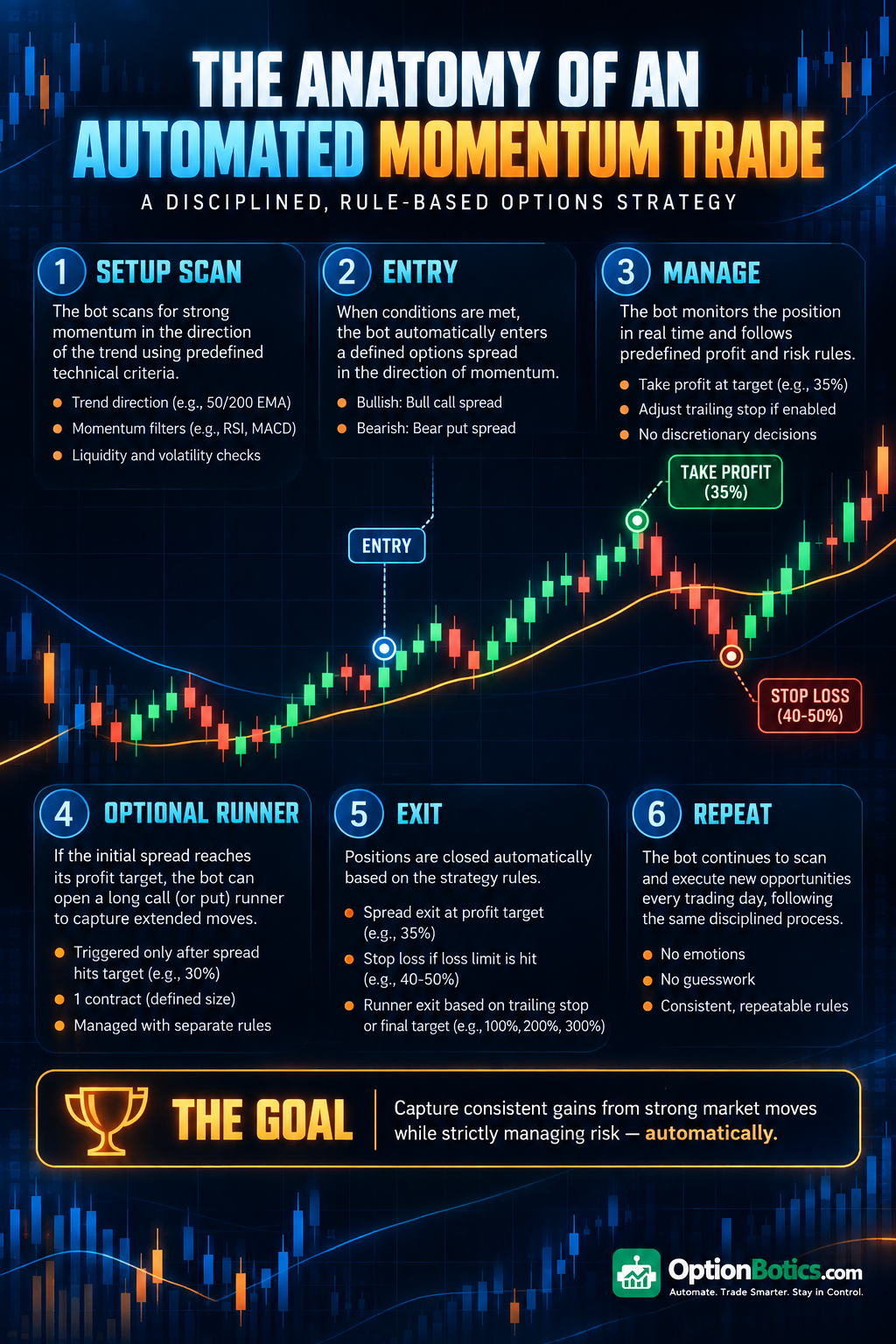
A complete automated momentum strategy can be thought of as a sequence of decisions. Each stage answers a different question before capital is committed.
Each decision needs an objective rule. The more ambiguity left in the strategy, the more difficult it becomes to automate and evaluate consistently.
Managing Risk in Automated Momentum Strategies
Momentum trades can reverse quickly. A breakout may fail, a strong trend can stall, or a volatility event can produce sharp movement in both directions. Automation therefore needs risk controls just as much as it needs entry logic.
- Maximum capital or risk allocated to each trade
- Defined-risk options structures where appropriate
- Limits on simultaneous directional exposure
- A maximum number of entries over a specified period
- Rules that prevent repeated entries after failed signals
- Loss or invalidation conditions that close a trade when the setup breaks down
Risk should also be considered at the portfolio level. Several bullish momentum trades across highly correlated symbols may behave more like one large directional position than several independent trades.
For a deeper framework, see trading bot risk management and how to prevent automated strategy blowups.
Exit Rules Matter as Much as the Momentum Entry
A momentum system needs a plan for what happens after the directional move begins – or fails to begin.
- A predefined profit target
- A maximum acceptable loss
- Underlying price moving back through the breakout or invalidation level
- A momentum or trend condition reversing
- A time-based exit when expected follow-through does not occur
- An expiration-based rule that prevents the position from being held too close to expiration
These approaches can also be combined. For example, a strategy might have a maximum-loss rule, a profit objective, and a time-based exit if neither occurs.
The important part is deciding those rules before the position is under pressure. See how to set up automated exit strategies for a more detailed look at rule-based trade management.
When Momentum Strategies Tend to Work Best
Momentum systems are designed for markets that actually move. They are generally better aligned with environments characterized by:
The same strategy can struggle when price repeatedly reverses around the entry level. Sideways or choppy markets can produce false breakouts and repeated directional changes that undermine momentum signals.
Market Regime Matters
This is why some automated systems include a market-regime filter. Instead of allowing a momentum strategy to trade under every condition, the system first determines whether the current environment meets the strategy’s broader requirements.
Some traders also monitor gamma exposure and market maker hedging conditions as an additional source of market-structure context. GEX does not predict whether an individual momentum trade will succeed, but it can provide another perspective on the environment in which the setup is occurring.
Common Mistakes with Automated Momentum Strategies
Entering Too Late
Waiting for too many conditions may produce an entry only after much of the directional move has occurred. The tradeoff between confirmation and timeliness should be tested rather than guessed.
Trading Every Breakout
A price crossing a line does not necessarily indicate sustainable momentum. Without meaningful qualification rules, an automated strategy may repeatedly trade noise.
Overtrading
Fast-moving markets can produce numerous signals. Position limits, cooldown rules, and daily trade limits can prevent the bot from continually re-entering similar setups.
Ignoring the Options Contract
A correct directional thesis does not automatically produce a profitable options trade. Expiration, strike selection, implied volatility, bid/ask spreads, and time decay can materially affect the outcome.
Ignoring Market Conditions
A strategy built for directional expansion can behave very differently in a low-volatility, range-bound environment. Market-regime assumptions should be part of the strategy design.
Weak Exit Rules
Momentum can disappear quickly. Without predefined exits, an automated entry can turn into a manually managed position precisely when emotion is highest.
Common Questions About Automated Momentum Strategies
Are momentum strategies good for automation?
They can be well suited to automation because their signals can often be expressed as objective rules and timing can matter. Automation can monitor those conditions and execute consistently, but it does not make an unprofitable momentum strategy profitable.
Do momentum strategies work in all market conditions?
No. Momentum strategies are designed to capture directional movement and can struggle during sideways or choppy periods. Testing across different market regimes is important.
What options strategies can be used for momentum?
Long calls, long puts, bullish or bearish debit spreads, and other directional structures can be used. The appropriate structure depends on the strategy’s expected move, timeframe, volatility assumptions, and risk limits.
Can technical indicators be used to automate momentum trades?
Yes. Indicators such as moving averages, RSI, and MACD can be incorporated into rule-based systems as signals or confirmation filters. Price action, volume, volatility, and multiple timeframes can also be used depending on the strategy.
Can beginners use automated momentum strategies?
A simple rules-based strategy may be easier to understand and evaluate than a system with many overlapping conditions. Regardless of experience level, traders should understand the entry, contract selection, risk, and exit logic before deploying an automated strategy with real capital.
Final Thoughts
Automated momentum strategies approach options trading differently from range-bound and premium-collection systems. Instead of benefiting primarily from time decay or price remaining inside a range, they attempt to participate when an underlying begins or continues a meaningful directional move.
The automation itself is only one piece of that process. A robust system still needs a clearly defined momentum signal, appropriate confirmation, deliberate options selection, position sizing, market-regime awareness, and exit rules.
When those decisions are defined in advance, automation can do what it does best: monitor the rules consistently and execute the strategy without changing the plan in the middle of the trade.