
Choosing an options trading bot is not just a matter of finding software that can place trades automatically. The more important question is whether the platform can execute your strategy accurately, manage risk consistently, and give you enough visibility to understand what it is doing.
A good bot should reduce repetitive work without turning trading into a black box. It should help you define rules, test ideas, manage positions, and monitor results while keeping you in control of the strategy.
This buyer’s guide explains the features that matter most, the warning signs to avoid, and the questions to ask before committing to an options automation platform.
Start With the Strategy, Not the Software
The most common mistake is choosing a platform because it looks advanced, then trying to force a strategy into whatever tools it provides.
A better approach is to start with the trading process you want to automate:
- What conditions should trigger an entry?
- What options strategy should be opened?
- How should strikes and expirations be selected?
- How much risk should be allocated?
- What conditions should trigger an exit?
- What should happen when the market changes?
If you are still defining that process, this guide to rule-based automated options trading provides a useful foundation.
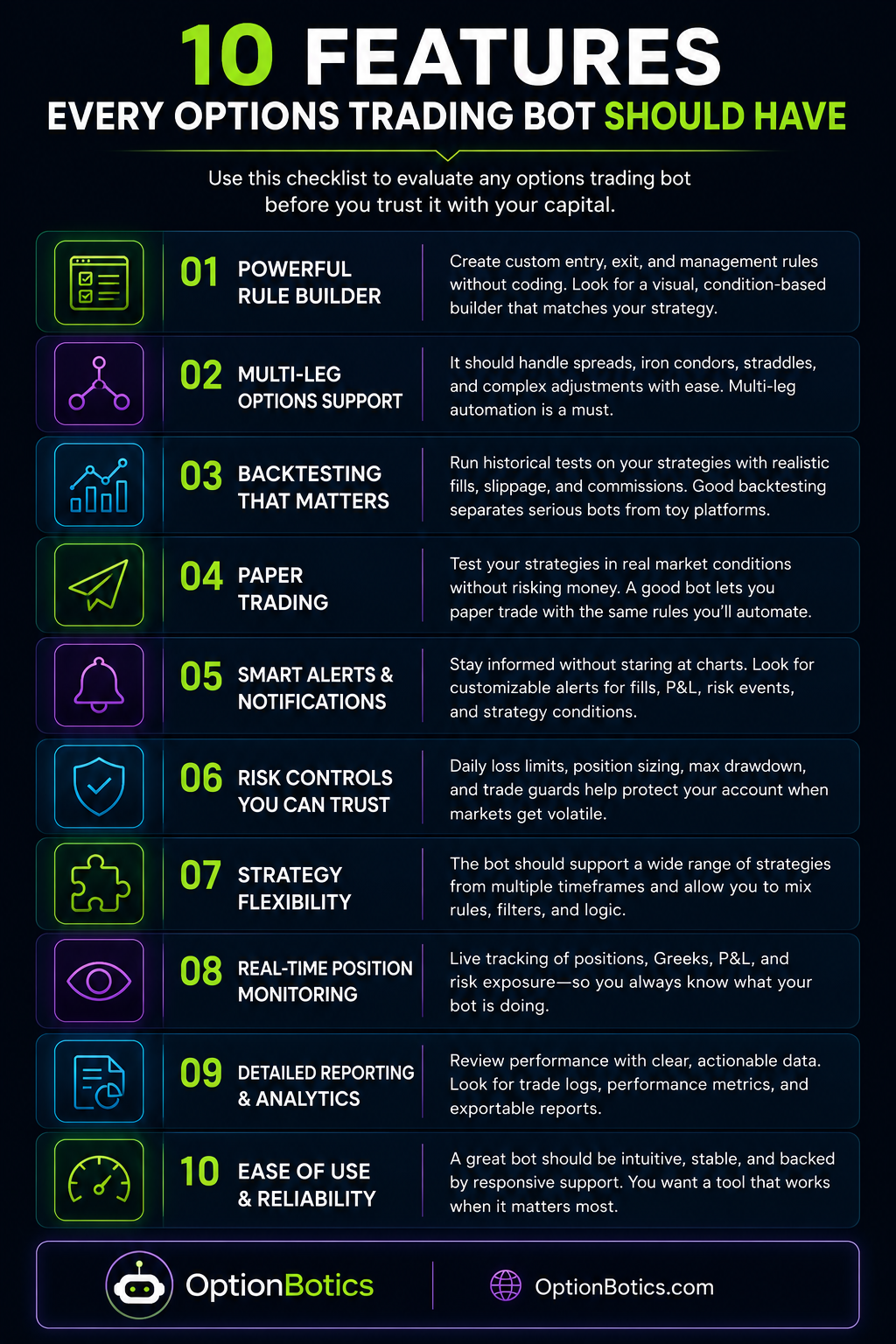
10 Features That Matter in an Options Trading Bot
1. A Flexible Rule Builder
The rule builder is the core of the platform. It should let you define clear conditions for entries, exits, risk controls, and monitoring without requiring you to write code.
Look for the ability to combine multiple conditions. For example, a bot might only enter when volatility is above a threshold, price is on the correct side of a moving average, and no conflicting position is already open.
A simple interface is useful, but simplicity should not come at the cost of flexibility. The platform should support both straightforward strategies and more advanced decision logic as your needs grow.
2. Multi-Leg Options Support
An options bot should be able to open and manage multi-leg positions as complete strategies, not just as disconnected individual contracts.
This matters for strategies such as:
- Credit spreads
- Debit spreads
- Iron condors
- Iron butterflies
- Covered calls
- Cash-secured puts
If the platform cannot reliably select, submit, and track multi-leg orders, it will be limited for serious options automation.
You can see how these workflows apply to automated credit spreads and automated iron condor strategies.
3. Backtesting That Matches the Live Logic
Backtesting is valuable only when the tested rules closely resemble what the live bot will execute.
A strong platform should let you test:
- Entry conditions
- Strike and expiration selection
- Position sizing
- Profit targets and stop rules
- Time-based exits
- Market and volatility filters
Be cautious when a platform shows attractive historical results but does not explain its assumptions about fills, slippage, commissions, or data quality.
4. Paper Trading Before Live Deployment
Paper trading gives you a chance to confirm that the automation behaves as intended in real market conditions without risking capital.
This stage is especially useful for identifying operational problems that a historical backtest may not reveal, including:
- Unexpected order timing
- Missed or partial fills
- Conflicting automations
- Position limits that do not behave as expected
- Exit rules that trigger too early or too late
A platform should make it easy to move from backtesting to paper trading and eventually to live execution without rebuilding the entire strategy.
5. Strategy Flexibility
The best options bot is not necessarily the one with the most built-in strategies. It is the one that gives you enough flexibility to express your own rules.
For example, you may want to automate:
- An opening range breakout entry
- A volatility-based credit spread
- A range-bound iron condor
- A momentum trade using calls, puts, or debit spreads
- A GEX-based filter that changes when trades are allowed
Review the platform’s logic carefully if your strategy depends on specialized conditions. The ability to automate a basic moving-average crossover does not guarantee that it can handle a more structured options workflow.
For examples of rule-based setups, review the opening range breakout automation framework and how traders use GEX to interpret market maker hedging.
6. Strong Risk Controls
Automation can execute a good risk framework consistently, but it can also repeat a bad one faster. Risk controls should therefore be built into the platform rather than treated as an afterthought.
Useful controls include:
- Maximum position size
- Maximum number of open positions
- Daily trade limits
- Portfolio allocation limits
- Symbol or strategy concentration limits
- Maximum loss or drawdown safeguards
- Rules that pause new entries when conditions become unstable
Risk controls should work at both the position level and the portfolio level. A collection of individually defined-risk trades can still create excessive exposure when they overlap or respond to the same market event.
This is explored in more depth in Trading Bot Risk Management: How to Prevent Blowups.
7. Automated Exit Management
Entries tend to receive most of the attention, but exits often determine whether a strategy remains consistent.
A capable platform should support multiple exit types, including:
- Profit targets
- Maximum-loss exits
- Time-based exits
- Days-to-expiration rules
- Underlying price triggers
- Option-value or return-based conditions
- Trailing or conditional exits
The system should also make it clear which rule closed the position and how that action affected the result.
For a more detailed framework, see how to set up automated exit strategies without losing control.
8. Monitoring, Alerts, and Audit Logs
Automation should reduce constant screen time, but it should not make your trading activity invisible.
Look for:
- Order and fill notifications
- Position alerts
- Bot activity logs
- Clear error messages
- Broker rejection details
- A history of decisions and triggered rules
These tools make it easier to understand why a bot acted, diagnose problems, and confirm that execution matches the strategy design.
The goal is less manual oversight without giving up visibility.
9. Clear Reporting and Performance Metrics
A bot should help you evaluate the strategy, not merely produce a list of trades.
Useful reporting includes:
- Total profit and loss
- Win rate
- Average win and loss
- Profit factor
- Maximum drawdown
- Performance by symbol, strategy, or time period
- Open and closed position history
Reporting should also make it possible to separate strategy quality from execution quality. A strategy may appear weak because of poor fills, or appear strong because a backtest relied on unrealistic assumptions.
10. Ease of Use Without Hiding Complexity
An options bot should make automation easier, but it should not hide important decisions behind vague labels.
The ideal platform strikes a balance:
- Simple enough to build and manage without coding
- Detailed enough to understand the logic
- Flexible enough to support more advanced rules over time
- Transparent enough to audit every action
Templates can help beginners get started, but you should still be able to inspect and modify the rules rather than trusting a strategy you do not understand.
A Practical Options Trading Bot Comparison Checklist
Use this table as a starting point when comparing platforms:
Red Flags to Avoid When Choosing an Options Trading Bot
Guaranteed Returns or Unrealistic Win Rates
No legitimate platform can guarantee profits. Be cautious when marketing emphasizes returns without clearly explaining risk, drawdowns, or assumptions.
Black-Box Strategies
If you cannot understand why trades are entered or exited, you cannot properly evaluate the risk. Automation should make rules more consistent, not less transparent.
No Paper Trading
Moving directly from a template or backtest into live capital creates unnecessary risk. Paper trading should be part of the deployment process.
Limited Risk Controls
A platform that can automate entries but cannot limit exposure, position size, or trade frequency is incomplete.
Weak Logging or Error Reporting
Broker rejections, unavailable contracts, and connectivity problems happen. The platform should clearly show what failed and why.
Automation That Requires Constant Babysitting
A bot should not require you to manually correct routine decisions throughout the day. At the same time, it should provide enough monitoring and alerts to keep you informed.
Questions to Ask Before You Commit
- ✓ Can the platform express my actual entry and exit rules?
- ✓ Does it support the options strategies I trade?
- ✓ Can I backtest and paper trade the same logic?
- ✓ Can I control both position-level and portfolio-level risk?
- ✓ Will I receive useful alerts when something fails?
- ✓ Can I review why each trade was opened or closed?
- ✓ Does the platform integrate with my broker?
- ✓ Can I start simply and add complexity later?
- ✓ Are fees and limitations clearly explained?
- ✓ Do I understand the strategy well enough to automate it responsibly?
Which Type of Trader Benefits Most?
An options trading bot may be a good fit if you already have a rule-based process but struggle with consistent execution, monitoring, or trade management.
It can also help if you want to:
- Run strategies during market hours without watching every tick
- Apply the same risk rules to every trade
- Test variations before using live capital
- Manage multiple strategies or symbols more consistently
- Reduce emotional changes to entries and exits
Automation is less useful when the strategy depends heavily on intuition, discretionary chart reading, or decisions that cannot be defined clearly.
If you want examples of strategies that translate well into rules, review these automated options trading strategy ideas.
Before You Choose a Platform
The right options trading bot should make your process more consistent, transparent, and testable. It should not promise to replace judgment, remove risk, or turn an unclear strategy into a profitable one.
Start by documenting your rules. Then evaluate whether the platform can test, execute, monitor, and report those rules without forcing you into a rigid workflow.
The platform featured on OptionBotics.com is designed for no-code options automation, strategy testing, paper trading, multi-leg workflows, and rule-based risk management. Review the platform’s capabilities against the checklist above before deciding whether it fits your trading process.
Common Questions About Choosing an Options Trading Bot
What is the most important feature in an options trading bot?
The most important feature is a flexible, transparent rule builder. If the platform cannot express your actual strategy logic, the rest of its features will have limited value.
Should beginners use an options trading bot?
Beginners can use automation, but they should understand the strategy first. Templates and no-code tools can simplify execution, but they do not replace knowledge of options risk.
Do I need backtesting and paper trading?
Both are strongly recommended. Backtesting helps evaluate historical behavior, while paper trading helps confirm how the automation performs in live market conditions.
Can an options bot prevent losses?
No. A bot can apply risk rules consistently, but it cannot eliminate market risk, gap risk, liquidity problems, or losses caused by a weak strategy.
Is a no-code platform enough for advanced strategies?
It can be, provided the platform supports flexible conditions, multi-leg options, portfolio-level controls, and detailed monitoring. The key is the depth of the rule builder, not whether code is required.
Final Takeaway
Choose an options trading bot based on how well it supports your strategy, risk framework, and need for transparency—not on marketing promises or the number of templates it offers.
The strongest platforms help you define decisions in advance, test them realistically, execute them consistently, and review every result. That is what turns automation from a convenience into a disciplined trading process.