
Automated options trading is often seen as a way to simplify trading. Define your rules, remove emotion, and let a system execute consistently.
In theory, that sounds like a clear advantage.
In practice, many traders end up frustrated. Strategies that looked solid in testing begin to break down. Drawdowns feel larger than expected. Results become inconsistent.
The issue usually isn’t automation itself—it’s the structure behind it.
Automation doesn’t fix a flawed strategy. It simply executes it more efficiently.
The Biggest Reasons Automated Options Strategies Fail
1. Overlapping Positions and Hidden Portfolio Risk
This is one of the most common—and most underestimated—problems in automated options trading.
When systems open multiple trades based on similar conditions, those trades often carry the same underlying risk. Several positions may appear diversified on the surface, but if they are tied to the same market behavior, they can move against you at the same time.
Automation makes this easier to overlook because it removes hesitation. If the rules say to enter, the system continues to enter—without considering how much exposure is already in place.
This leads to:
- Stacked positions in the same direction
- Hidden correlation across tickers
- Compounding losses during adverse moves
- Drawdowns that feel disproportionate to individual trade size
What appears to be a series of small, defined-risk trades can behave like one large position when markets move quickly.
2. No Defined Risk Framework
Many automated strategies define entry and exit rules but ignore portfolio-level risk.
Without clear limits, systems may:
- Continue opening trades even when exposure is already elevated
- Allocate too much capital to similar strategies
- Fail to account for correlation between positions
Individual trades may be controlled, but the overall system is not.
3. Poor Entry Timing and Volatility Clustering
Markets tend to move in clusters. Volatility expands and contracts in waves, and trends can persist longer than expected.
Automated systems that enter trades without spacing or filtering can unintentionally concentrate positions during unfavorable conditions.
- Multiple trades entered during volatility spikes
- Entries clustered before strong directional moves
This creates timing risk at the portfolio level, even if each trade follows the rules.
4. Letting Trades Run to Expiration Without Management
Holding positions to expiration can increase exposure to late-stage risk, especially when managing multiple trades.
Common issues include:
- Holding through unfavorable price moves near expiration
- Missing opportunities to take profits earlier
- Increased sensitivity to rapid price changes
Without defined exit rules, trades can drift into outcomes that were never part of the original plan.
5. Over-Optimized Backtests
Backtesting is useful, but it can also be misleading.
Strategies that are heavily optimized for past data often rely on conditions that do not repeat consistently. Small adjustments can produce large changes in results, creating systems that perform well historically but fail in live markets.
What Actually Works: A Practical Framework
Successful automated options trading strategies are built on structure, not prediction. Instead of relying on perfect signals, they focus on managing exposure and maintaining consistency.
Space Entries Over Time
Spreading entries across different days reduces clustering risk and helps expose the system to a wider range of market conditions.
Limit Concurrent Positions
Setting a cap on open positions prevents overexposure and reduces the impact of correlated losses.
Mix Expiration Cycles
Using different durations—such as 30–45 DTE alongside shorter-term trades—can help smooth performance across varying conditions.
Define Profit-Taking and Exit Rules
Clear exit rules are essential. This may include:
- Taking profits at a defined percentage
- Cutting losses at predetermined thresholds
- Exiting before expiration to reduce risk
Think in Terms of Total Portfolio Exposure
Rather than evaluating trades individually, consider how they interact together. The key is understanding total capital at risk and how positions behave collectively.
An Example of a Simple Structured System
- Focus on 30–45 DTE defined-risk trades
- Spread entries across multiple days
- Use a mix of uncorrelated tickers
- Limit the number of concurrent positions
- Take profits at ~45% of max gain
- Manage trades before expiration
This type of structure prioritizes consistency and exposure control over trying to time perfect entries.
A Real-World Example of Structured Automation
Running since July 30, 2024, with each position capped at $500 in total risk.
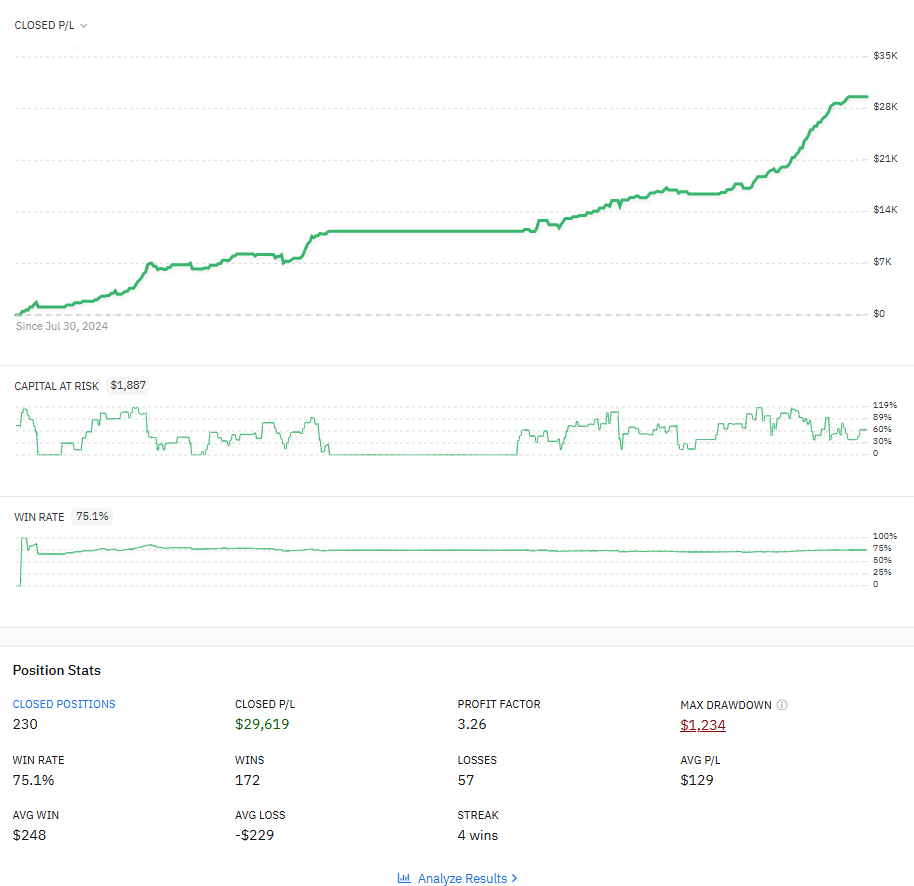
The equity curve reflects steady growth with relatively controlled drawdowns, which is a direct result of limiting overlapping risk and maintaining consistent trade management.
To see how these principles play out in practice, consider a structured automation system that has been running since July 30, 2024. The bot focuses on 30–45 DTE defined-risk trades across multiple uncorrelated tickers, with positions managed using a ~45% profit target and consistent sizing.
Across 230 closed positions, the system generated $29,619 in total P/L with a 75.1% win rate (172 wins, 57 losses) and a profit factor of 3.26. The average profit per trade was $129.
More importantly, the relationship between wins and losses is balanced. The average win was $248, while the average loss was -$229. This creates a more stable expectancy profile, where no single loss significantly outweighs multiple gains.
Risk control is also evident in the max drawdown of $1,234, which is relatively contained given the total number of trades. This suggests that position sizing, exposure limits, and trade distribution are working together effectively.
The key takeaway is not the performance itself, but how it was achieved. The system does not rely on perfect timing or complex signals. Instead, it applies consistent rules around entries, exits, position limits, and diversification across tickers.
This is what structured automation looks like in practice: repeatable decisions, controlled exposure, and outcomes that are driven by process rather than prediction.
Key Takeaways
- Automation is an execution layer, not an edge
- Most failures come from poor structure, not bad signals
- Overlapping positions can create hidden portfolio risk
- High win rates do not guarantee profitability without risk control
- Consistency matters more than complexity
When automation is paired with structured rules, it becomes a tool for enforcing discipline rather than amplifying mistakes.
If you want to explore how structured, rule-based systems are built and managed in practice, review the workflows and examples featured on OptionBotics.com.
For additional breakdowns on automation, risk management, and building consistent strategies, explore more guides on OptionBotics.com.