
Automating options trading can improve consistency—but without proper risk management, even well-designed strategies can fail.
This guide explains how to manage risk when using trading bots, focusing on the real issues that cause automated strategies to break down over time.
While automation removes emotion, it does not remove risk. In fact, poorly structured automation can accelerate losses if key safeguards are not in place.
Why Risk Management Matters in Automated Trading
Automation ensures trades are executed consistently—but that consistency applies to both wins and losses.
If a strategy has weak risk controls, a bot will follow those flawed rules perfectly. This is why risk management is more important than the strategy itself.
The goal is not just to generate trades, but to control how much risk is taken across all positions.
For a deeper setup guide, see how to build automated exit strategies for options trading.
The Biggest Risk in Trading Bots (That Most Traders Miss)
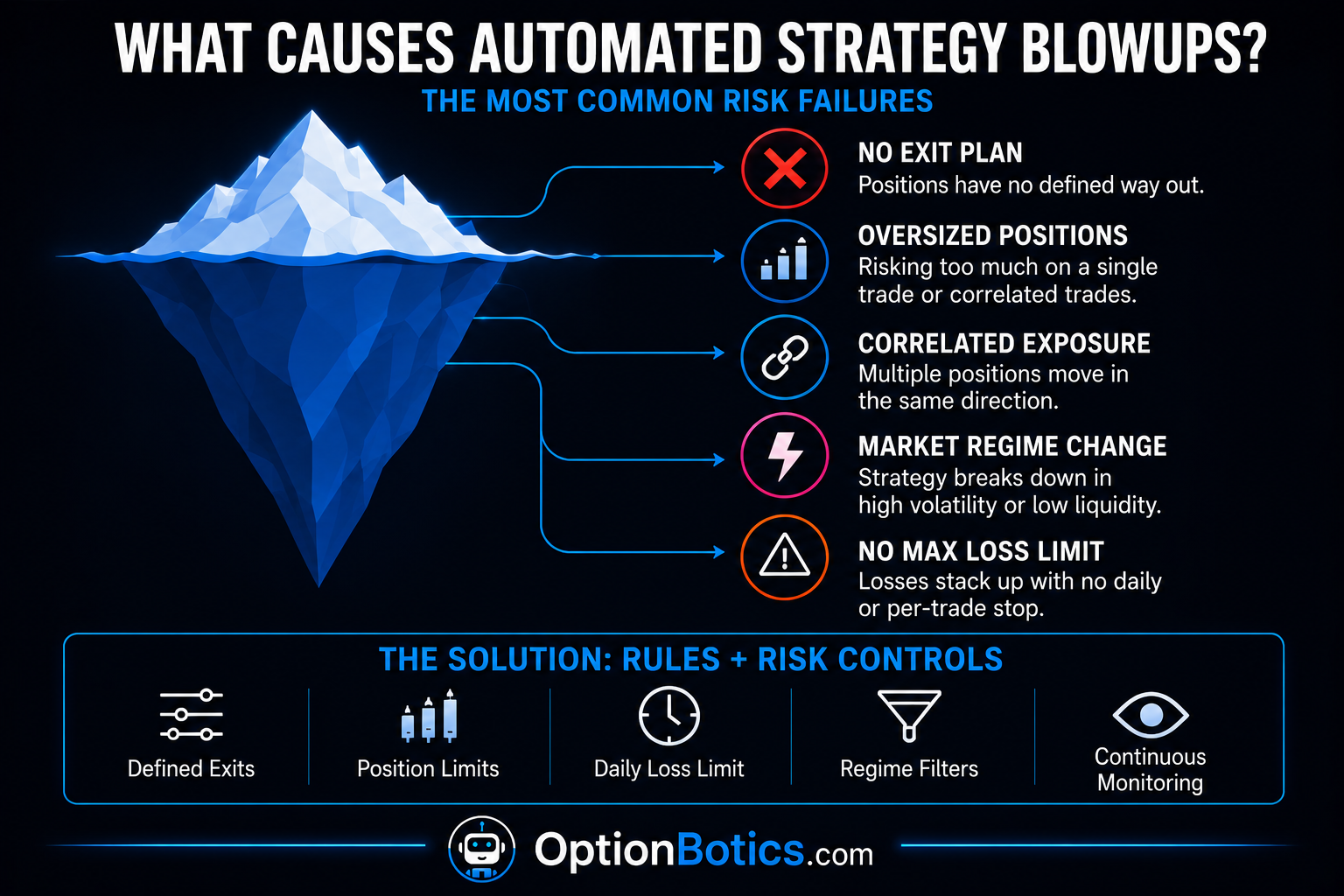
The most common issue is not a bad entry signal—it’s uncontrolled exposure.
This happens when:
- Too many positions are opened at the same time
- Trades are placed on highly correlated assets
- Risk per trade is too large relative to account size
- Multiple strategies overlap without coordination
Individually, each trade may look safe. But together, they can create hidden portfolio risk that leads to large drawdowns.
Core Risk Management Rules for Automated Strategies
- Limit Position Size
Each trade should risk only a small percentage of your total account. This prevents a single loss from significantly impacting your portfolio.
- Control Total Exposure
Set limits on how many positions can be open at once. Even good strategies can fail when too many trades are active simultaneously.
- Avoid Correlated Trades
Opening multiple positions on similar assets can amplify losses if the market moves against you.
- Use Defined-Risk Strategies
Strategies like credit spreads and iron condors limit maximum loss, making them easier to manage in automated systems.
Why Exit Rules Matter More Than Entry Rules
Many traders focus on finding the perfect entry signal—but long-term performance is often determined by how trades are managed and exited.
Without clear exit rules, bots may:
- Hold losing trades too long
- Miss opportunities to lock in profits
- Allow small losses to grow into large ones
Common exit rules include:
- Closing at a fixed profit percentage
- Exiting when a loss threshold is reached
- Time-based exits (e.g., end of day or expiration)
See: How to Set Up Automated Exit Strategies in Options Trading (Without Losing Control)
How to Prevent Strategy Blowups
Most automated strategy failures are not caused by a single trade—they happen when multiple risks combine at the same time.
To reduce this risk:
- Limit the number of trades per day
- Use volatility filters to avoid extreme conditions
- Space out entries instead of clustering trades
- Monitor total portfolio risk, not just individual positions
These controls help prevent scenarios where multiple losses occur at once.
How Automation Helps (When Done Correctly)
When combined with strong risk rules, automation becomes a powerful tool for consistency.
Instead of making decisions in real time, you define:
- How much to risk per trade
- When trades are allowed
- How positions are managed
- When to exit
This ensures that every trade follows the same structure—making results easier to evaluate and improve.
See: How to Automate Options Trading Without Coding (Beginner-Friendly Guide)
Good systems should reduce screen time while still preserving structured oversight through automation.
Common Questions About Trading Bot Risk Management
What is the biggest risk in automated trading?
The biggest risk is uncontrolled exposure—opening too many positions or taking on too much total risk at once.
Can automation prevent losses?
No. Automation improves consistency, but losses are still part of trading. Risk management determines how large those losses can become.
How much should I risk per trade?
Many traders risk a small percentage of their account per trade, often between 1% and 5%, depending on their strategy.
Do I still need to monitor a trading bot?
Yes. While bots execute trades automatically, they should still be monitored to ensure they are performing as expected.
Final Thoughts
Automation does not eliminate risk—it amplifies whatever rules you put in place.
The key to long-term success is not just finding a strategy, but controlling how risk is managed across every trade.
If you want to see how traders are building structured, risk-managed automation systems, review the tools and workflows featured on OptionBotics.com.