
Credit spreads combine limited profit potential with defined risk, making them a natural candidate for systematic options trading. But automating them requires more than telling a bot to sell premium.
A complete automated credit spread strategy needs rules for finding opportunities, selecting strikes, controlling position size, entering multi-leg orders, managing risk, and deciding exactly when to exit.
What Is a Credit Spread?
A credit spread is an options strategy where you sell one option and buy another option with the same expiration but a different strike price. The trade produces a net credit at entry.
The purchased option limits the potential loss, giving the position defined maximum risk as well as limited maximum profit.
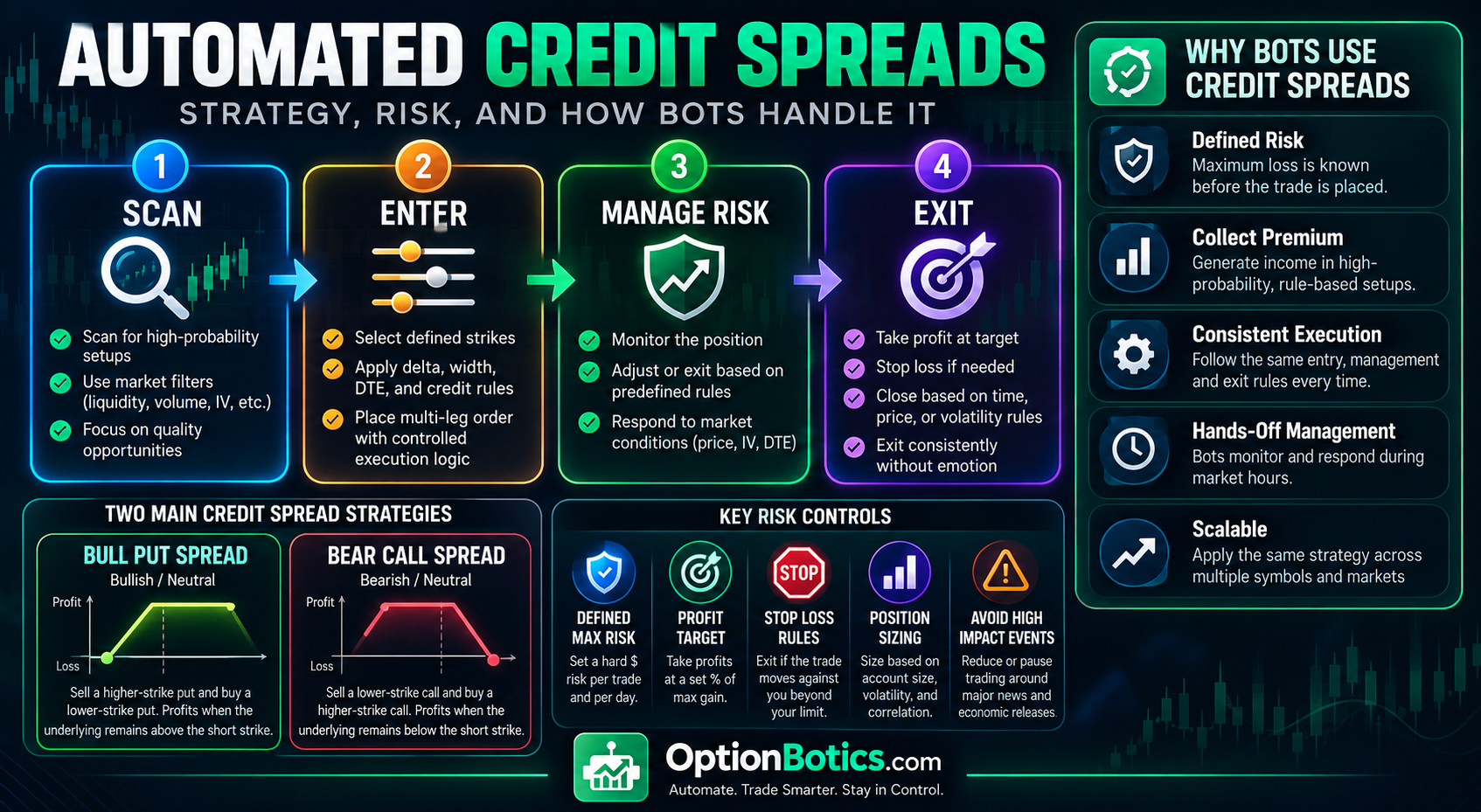
Why Credit Spreads Work Well With Automation
Credit spreads involve a series of repeatable decisions. Those decisions can often be translated into explicit conditions that a bot can evaluate consistently.
A Typical Automated Credit Spread Workflow
1. Scan for Suitable Setups
The process begins by narrowing the market to opportunities that meet the strategy’s requirements. The original framework uses filters such as:
- Liquidity: sufficient activity and reasonably tight bid-ask spreads.
- Implied volatility: IV Rank above a defined threshold, such as IVR > 40% when the strategy is seeking higher premium.
- Underlying behavior: price action that fits the directional or range assumptions of the selected spread.
The goal is not to sell a spread simply because premium exists. The bot should first determine whether the market environment fits the rules the strategy was designed around.
2. Select the Spread
Once a setup qualifies, automation can apply predetermined rules to choose the actual position.
Bull put or bear call spread
Target delta
Defined spread width
Minimum acceptable credit
This is one of the most useful aspects of automating spreads: contract selection becomes part of the strategy rather than an improvised decision made after a signal appears.
3. Size the Position
A defined-risk trade still needs position-size limits. A bot should know how much capital can be allocated before it submits an order.
Position sizing can be based on a maximum percentage of account equity, maximum dollar risk, number of spreads, or another predefined portfolio rule.
4. Submit the Multi-Leg Order
After the position passes the entry and sizing rules, the bot can submit the spread as a multi-leg order.
Limit-order logic can help control execution quality. If the spread cannot be filled within the strategy’s acceptable price range, the automation can reprice according to its rules or decline the trade rather than accepting an unfavorable fill.
Managing the Spread After Entry
Opening the trade is only half of the automation problem. A useful credit spread bot also needs explicit instructions for what happens after entry.
Example Credit Spread Bot Rules
A rules-based credit spread workflow might look like this:
FILTER for sufficient liquidity and IV Rank above the required threshold
SELECT the spread direction based on the strategy’s market criteria
CHOOSE strikes using the predefined delta and width rules
VERIFY minimum credit and maximum permitted risk
ENTER using controlled multi-leg order logic
MONITOR profit, loss, price, volatility, and expiration conditions
EXIT when the first applicable management rule is triggered
The specific values are less important than the structure. Every decision that would normally be made manually needs a rule the automation can evaluate.
The Risk Side of Credit Spread Automation
Automation can improve consistency, but it cannot eliminate the fundamental risks of selling option premium.
Backtesting Before Going Live
A credit spread bot should be tested before real capital is committed. Historical testing can help evaluate whether the entry and management logic behaves as expected across different market environments.
Useful variables to examine include:
Paper trading adds another layer of testing by showing how the automation behaves with live market data, including order timing and fill behavior that may not be fully represented by historical results.
What to Monitor After Deployment
Automation does not make a credit spread strategy maintenance-free. Once a bot is running, review both its trading performance and its operational behavior.
- Win rate and average profit/loss to understand the distribution of outcomes.
- Profit factor and drawdown to evaluate performance relative to risk.
- Fill quality and slippage to determine whether live execution resembles the assumptions used during testing.
- Strategy concentration to avoid accumulating excessive correlated exposure.
- Rejected or unexpected orders to identify operational problems.
- Performance across market regimes to determine whether results change as volatility or trend conditions shift.
The Bottom Line
Credit spreads are well suited to rule-based automation because much of the workflow can be defined before a trade occurs: market filters, strike selection, spread width, position size, entry price, profit targets, loss limits, and expiration management.
The bot’s job is to apply that framework consistently. The trader’s job is to build and test the framework, control portfolio exposure, monitor execution, and determine whether the strategy continues to behave as intended as market conditions change.